My 9 Albums
8 days ago
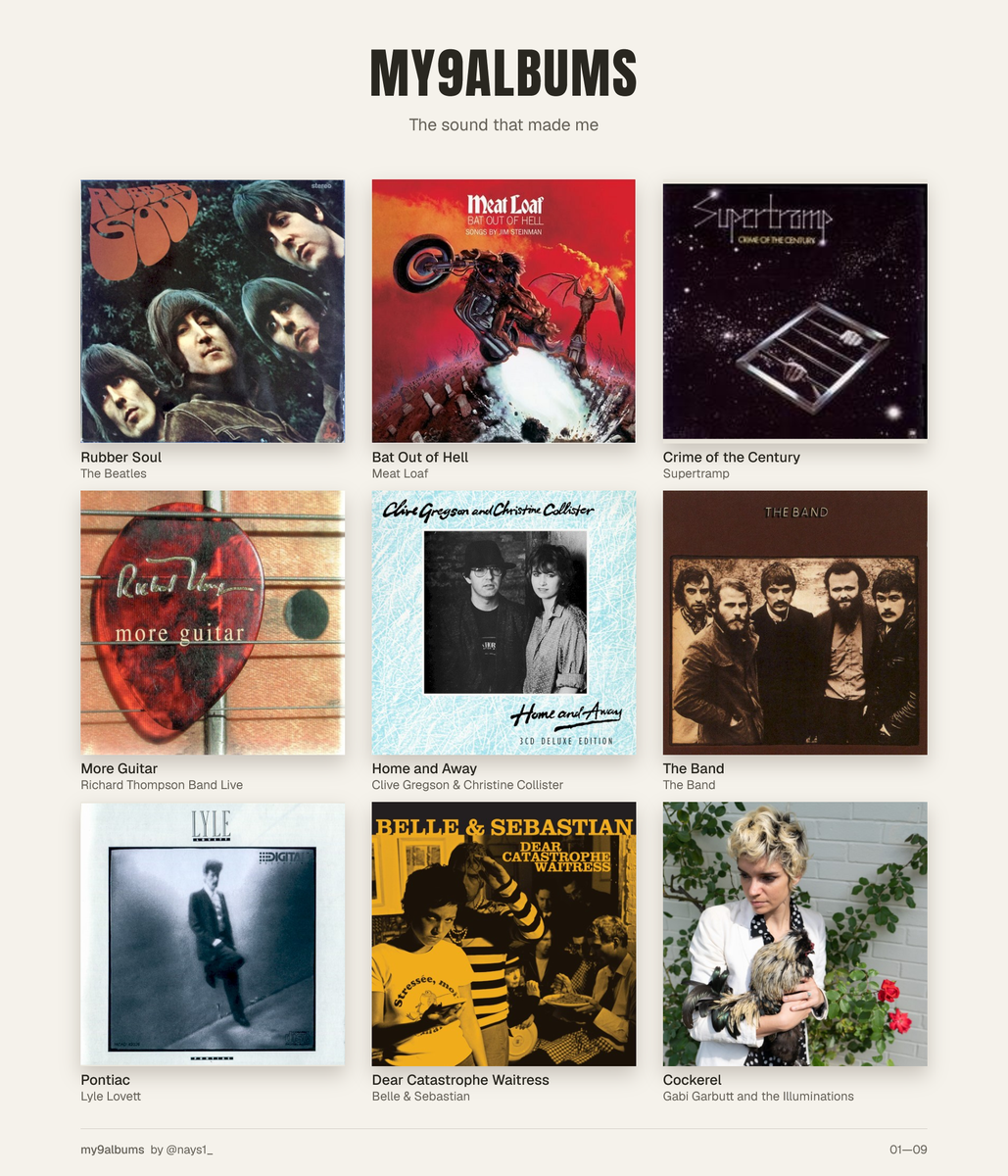
I’ve held out for a while, because I knew how agonising it would be, but I’ve finally had a go at the ‘My 9 albums’ thing that’s, ahem, sweeping the internet. The idea is to pick ‘the nine albums that made me’, and that’s where it gets tough – how to whittle my favourites from more than 40 years as an active music fan down to just 9 albums? There are artists who haven’t made the cut who I could never have imagined leaving out, and classic albums bordering on perfection which I haven’t selected.
I toyed with narrowing the field by only considering albums that I encountered in the earlier part of my fandom – say, up until I finished University – as these arguably had more of a claim to be formative, but again there was too much ruled out by such an arbitrary deadline. Here’s the final nine:
Rubber Soul by the Beatles. The Beatles is where it all began for me – I can remember a classmate at primary school asking me why I liked them more than his favourite band of the time, the Electric Light Orchestra (who I also liked a lot). The fact that ELO were hugely influenced by/derivative of (delete as appropriate) the Beatles was lost on both of us at the time. I was tempted to select both of the 1970s compilation albums, commonly known as the Red album and the Blue album, which was my first proper immersion into their music, but I loved both equally and I didn’t want to take up two of the precious 9 slots. Rubber Soul narrowly edges out Revolver as my favourite Beatles album, so it gets the nod. If you don’t think they were the best band in the history of pop music, you’re wrong.
Bat Out of Hell by Meat Loaf. This is the album that opened my teenage eyes to the fact that the heavier end of the rock spectrum still had room for genuine emotion and heartfelt lyrics. Sometime in the early 1980s, I was at home listening to Radio 1, and Simon Bates’ corny romantic cliché-fest Our Tune was on the air. When he announced that the song the heartbreaking story was anchored in was by Meat Loaf, I almost laughed, my prejudice against heavy rock’s supposed shallows getting the better of me. Long before the end of the track (For Crying Out Loud, if you’re interested), I was converted. I asked to borrow the album from a longhair friend and the river of my musical taste underwent a crucial change of course. The album gets a mention in Dead Man Singing as one of the few selections to survive the ruthless tour bus soundtrack veto system, a nod to the fact that within the broad expanse of rock fans of any flavour, there’s usually an affection for it.
Crime of the Century by Supertramp. In my last few years of school, Supertramp were my favourite band. It’s probably fair to say that for a couple of years in my teens, there wasn’t a day went by without me listening to something by them, and Crime of the Century remains the absolute high-water mark of their career. I loved it then, and I love it just as much now. It’s a good contrast to the previous choice too, emphasising the melodic side of rock music over the heavier tones of Mr Loaf.
More Guitar by Richard Thompson. More than anyone, Richard Thompson had to feature somewhere in this list , but I’ve always struggled to identify a definitive ‘best’ album from his vast back catalogue. I’ve opted for one of his official live bootleg albums, not least because his best guitar work comes when he’s in front of an audience at the head of a band. The soloing on this version of Can’t Win helps to explain just why he’s so far ahead of the competition as my favourite guitarist. The album also has a live version of The Angels Took My Racehorse Away, which was a favourite of mine when I first heard him play it live in 1986, and which has only made sporadic but always welcome appearances in the set on the many ocassions I’ve seen him play since.
Home and Away by Clive Gregson and Christine Collister. I first encountered them as part of Richard Thompson’s band in the 1980s, but they soon became firm favourites in their own right. One great songwriter/guitarist (Gregson), two great vocalists. For most people, the 80s was a time of production excess; Gregson and Collister showed that a stripped-back acoustic setting still allowed songs to connect, and that truth has remained at the heart of my taste in music ever since. This is possibly the most obscure choice I’ve allowed myself, and also one of the most personal. In a parallel world somewhere, Christine Collister is universally recognised as one of the greatest vocalists of all time, and I want to live in that world.
The Band by The Band. Their second album – I could easily have picked its predecessor Music From Big Pink, or their farewell live album The Last Waltz. Discovering The Band was a doorway into Americana (not that we called it that back then) and my appreciation of many other of my favourites has come through that route. As I’ve argued before, there’s a case to be made for The Band as the most influential act in 20th century music after the Beatles. It’s certainly true to say that if I had never discovered their music, Dead Man Singing would have been a very different book.
Pontiac by Lyle Lovett. This is here as a representative of two strands in my musical taste. First of all, a liking for country music that is part of the legacy The Band has given me, and secondly a willingness to be wide-ranging and eclectic in my listening, something which was nurtured by the eclectic playlist of Andy Kershaw’s undefinably great Radio 1 show back in the late 1980s, which is where I first discovered Lyle Lovett, among others.
Dear Catastrophe Waitress by Belle and Sebastian. Another of my favourite bands, and another where I struggled to identify one album out of a phenomenal back catalogue. I had been aware of them for several years before I ever checked them out, but Stuart Maconie’s prolonged spell covering for Johnny Walker’s illness on the Radio 2 drivetime show led me to try a couple of albums and I was hooked. To put it at its simplest, listening to Belle and Sebastian makes me feel happy, even on their gloomier material. They will be making an appearance in a forthcoming installment of the A-Z of Imogen Imagine, but you'll just have to be patient for that.
Cockerel by Gabi Garbutt. This album is included very much on its own merits, but also as a representative of the fact that I still seek out new music rather than just living in the 70s and 80s. Other contemporary artists such as Hamish Hawk or Grace Petrie could just have easily taken the spot. However, I've opted for Garbutt, a powerhouse lyricist who fuses her words with exhilarating musical accompaniment. She’s another writer who mines the darker side of life, but simultaneously infuses her work with a sheer joy that takes listeners with her. This was the first of her albums I heard, and it’s still my favourite (though the others are worth your attention too.)
Some notable omissions. Perhaps there should have been a place for a genuine prog rock act – probably Genesis, possibly Yes or Camel. It’s inconceivable that I didn’t find room for Bob Dylan or Billy Bragg, and there are a whole host of perfect albums whose absence pains me (Fleetwood Mac’s Rumours, Who’s Next by the Who, Joni Mitchell’s Blue, World Party’s Goodbye Jumbo, John Hiatt’s Bring the Family, Del Amitri’s Waking Hours, Native Sons by the Long Ryders…). Even stopping the list of the omitted there and not mentioning other favourites is a wrench.
I said this was going to be a brutal exercise for me. That said, maybe it will be less painful if I had to think about how Dave Masters from Dead Man Singing would go about the task? Watch this space, I might just give it ago.
There are no comments yet, be the first to comment...
Your comment will first need to be approved before it is visible.