Book review: The Power and the Glory
110 days ago
The FIFA world cup begins today. The first World Cup that I remember was 1978. England hadn’t qualified, but Scotland had. I can remember hearing on telly for weeks that ‘Scotland had qualified for the World Cup finals’, not registering that vital ‘s’ on the end and thinking that Dalglish and co were one game away from being World Champions. When I eventually saw a list of the 16 nations (only 16 then – a far cry from the 48 competing this time) who were taking part, I began to realise it was a bit bigger than that. Of course, once the tournament started, I was smitten, watching as many games as I could and discovering new exotic footballers – Platini! Cubilas! Kempes! – from far-flung corners of the world (well, mostly Europe and South America in those days). I was hooked.
I’ve approached this year’s tournament with less enthusiasm, if I’m honest. In recent years, FIFA has increasingly seemed like a less-than wholesome guardian of the world’s favourite game, with bribery and corruption blighting the bidding processes for hosting the event, and financial concerns seeming to override sporting ones at every turn. The prospect of the tournament being hosted in Trump’s America (alongside the far less odious Mexico and Canada) seems at the same time ghastly and somehow the perfect fit for where FIFA finds itself in 2026.
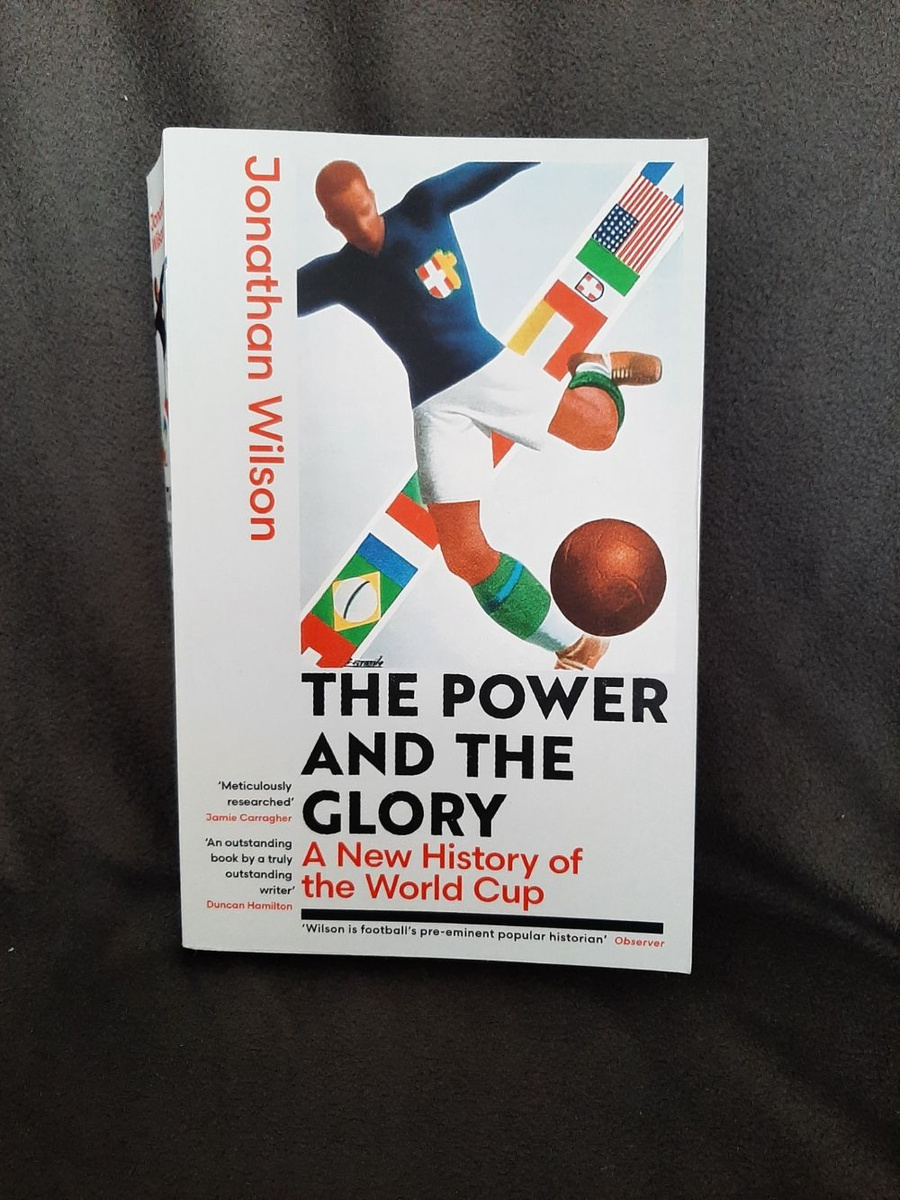
And yet… a historical perspective has brought me back to the tournament. As I’ve written here before, Jonathan Wilson is one of my favourite football writers. He combines sharp analysis with accessible, readable prose and above all the ability to put individual moments of football history into a broader perspective. It was reading his latest book, The Power and the Glory: A New History of the World Cup that reignited the flame for me.
One interesting theme that emerged is that the World Cup has always been about more than just the football. The pioneer of the tournament, Frenchman Jules Rimet, wanted to use football to foster understanding between different nations. Despite that noble concept, from its earliest days, the World Cup has also been co-opted by politicians, with Mussolini using the 1934 tournament as an endorsement of his vision of a vigorous, muscular Italy (they were both the hosts and the eventual champions). Throughout the tournament’s history, politicians good and bad have sought to benefit from the association, and a well-timed moment of success has proved to play a vital part in many countries' wider conception of national identity. West Germany’s unexpected success in 1954 proving to be a significant factor in that nation defining itself beyond the horrors of the previous two decades; Argentina’s military junta invested much energy (and, it has long been suspected, tapping up of match officials) to ensure the maximum propaganda value from playing hosts in 1978.
The arrival of Joao Havelange as FIFA President in 1974 marked a significant shift. The idealistic vision of Rimet was diverted to another international language: greed. The shameless era of Sepp Blatter and Gianni Infantino have their roots in Havelange’s time, and Wilson, despite being a football man to his boots, doesn’t shy away from holding a mirror up to each of them. The cynicism that certain aspects of the modern game could provoke isn’t ignored, but still the love for the actual game is given room to flourish. It’s a sobering thought that one recent development (which I’m sure Havelange would have approved of) is that now FIFA has redrawn financial rules in such a way that host countries don’t make anything like the fortune they once did from the tournament. Fifa can now hoover up even more of the profit, then skip town leaving the host with an abundance of white-elephant stadiums that cost more in upkeep than they are ever likely to earn again.
Where Wilson shines is in the details. We are used to individuals becoming the definition of a particular tournament – Pele in 1970, Maradonna in 1986 – but Wilson is able to pick out the less obvious characters whose personal journey helps us to understand the bigger picture year by year. He personalises each tournament and brings it to life, whether it’s one that the reader can remember personally (1978 onwards for me) or one which we can only ever partake of second hand.
England’s arrogantly high-handed approach to the rest of the world in the early days has been well documented elsewhere, but we weren’t the only British nation to now look foolish with the benefit of hindsight. The Scots only took 13 players, two of them goalkeepers, to the 1954 tournament (they were allowed up to 22). Tam Reid, head of the selection committee, was also quoted as saying, ‘Our forwards have been instructed to go all out for an early goal, knowing from experience that the continentals don’t like to fight back.’ Four years later, Wales decided to save money by only taking 18 players, while also finding room in their travelling party for no fewer than 16 Football Association of Wales directors. The twin British traits of assumed superiority and of prioritising the ruling class lay at the root of our relative lack of success in the early days of international competion.
Wilson’s triumph in the book is to rekindle that childlike joy that the World Cup gives to millions, while simultaneously demanding a more sober, mature assessment of everything that runs alongside. Here you’ll find salutes to the winners and the almost winners – Hungary only lost one match out of 54 in a six year period around 1954, but that one was the one that counted, the World Cup Final still known in Germany as 'the miracle of Berne' – as well as judgment on the men who used the tournament for their own ends.
Strangely, the reminder that the World Cup has always trod a difficult path between the pure joy of sport and the corrupting influence of nationalism has helped me to feel more comfortable with what we’re likely to see over the next few weeks. As with so many other things in life, the golden age we hark back to was never as idyllic and pure as we imagine it to be. Football is still Pele’s beautiful game, and the ugliness that accompanies it in the modern world has always been there as well. We may live in an imperfect world, but there are still moments of grace to enjoy and celebrate. That’s what I’m hoping to see in the coming weeks.
There are no comments yet, be the first to comment...
Your comment will first need to be approved before it is visible.