Andy Kershaw obituary
21 days ago
‘Hello and welcome to another Thursday night with fingers poised on the record button.’
I first encountered Andy Kershaw when he joined the presenting team of Whistle Test (‘No longer old, no longer grey!’ as I still remember him ironically enthusing to camera). Prior to that he had worked as road manager and guitar tech for Billy Bragg at a time when the latter’s road crew consisted of [checks notes] Andy Kershaw, and he subsequently went on to present shows for Radio 1 for fifteen years, as well broadcasting for other stations too.
It’s the radio version of Kershaw that I remember most fondly. I was a regular listener during my student days and after. I made compilation tapes of songs I had recorded from his shows, songs by artists I had never heard of before and in some cases never heard of again, but which were wide-ranging and eclectic and simply too good to be left at just one listen. Lots of people my age reminisce about the bands they first heard on John Peel’s shows, but for me it was Kershaw who became my most reliable source of new favourites.
Kershaw’s approach was heavily influenced by John Walters, the producer he shared with Peel. Walters asserted that ‘We’re not here to give the public what it wants. We’re here to give the public what it didn’t know it wanted.’ Boy, there was a lot of music I didn’t know I wanted but loved once I heard it. Kershaw’s later days with Radio 1 coincided with John Birt’s regime at the BBC, and it was only a matter of time before Radio 1 Controller Andy Parfitt brought the Kershaw show to an end. Our hero probably didn’t help himself by accepting the role of writing a weekly column as a radio critic with the Independent newspaper, which the Guardian’s Francis Wheen (a friend of Kershaw’s) described as ‘the most suicidal column in the history of journalism’. When the end finally came, Kershaw didn’t go quietly (as if) and beat Parfitt to the public punch by announcing live on air that the show his audience were currently listening to would be his last on the Nation’s Favourite. A bemused studio guest Warren Zevon even amended the lyrics in his in-studio performance of Lawyers, Guns and Money to reflect an anecdote Kershaw had shared about being stuck in the middle of the Angolan Civil War, armed only with a copy of the song in question.
Kershaw was as likely to be found at gigs by The Clash, country legend Tammy Wynette, roots reggae stars Culture, soul shouters like Barrence Whitfield and the Savages or quirkily unique songwriters like Robyn Hitchcock. It was Kershaw who first introduced Tracy Chapman and Tanita Tikaram to the British airwaves. He was the first to play Ali Farka Toure on British radio and he championed acts like the Bundhu Boys, arranging their UK tours, putting singer Biggie Tembo up at his own home on numerous occasions, and even inviting him to spend Christmas with his family in Rochdale. In an era where music was pigeonholed and fans were defined by their tribes, Kershaw was gloriously free-ranging in his own listening, and that fact was reflected on his show. Some of the artists he championed became firm favourites of mine for many years – a session by Lyle Lovett in 1988 blew me away from the first note, and I went on to buy many of the long, tall Texan’s albums, as well as seeing him in concert on several occasions. Others left me with just one glorious, exhilarating track – like Jim Ford’s Harlan County, or The Colorblind James Experience’s Considering a Move to Memphis – to cherish and play endlessly on my home-made compilations. Any given show could see vintage blues or country give way to post-punk edginess, 60s psychedelia, or to hitherto unheard-of World Music in many flavours and vintages. I still occasionally listen to an album of Hungarian folk music by Márta Sebestyén and Muzsikas that I discovered through Kershaw (the song Repulj, Mahar, Repulj (Fly, Bird, Fly) remains a breathtakingly frail delight even though I don't understand a word of it). There’s a Spotify playlist that someone has compiled to celebrate Kershaw’s musical largesse, and it gives a good idea of the range of his show.
Andy Kershaw was a music enthusiast – even to the extent of leaving a 3-hour A level exam in his native Rochdale halfway through, so he could catch a train to see Bob Dylan play in London that night – but music wasn’t his only enthusiasm. His regular trips to far-flung corners of the world to gather music led to him becoming part of the roster for Radio 4’s From Our Correspondent series, as well as the Today programme and The World Tonight. He reported for the BBC on such events as the Rwandan genocide and the Angolan Civil War, as well as going to North Korea four times, initially (after spending five years requesting permission to go) for Channel 4’s Travelogue series. Apparently on one occasion in the Democratic People’s Republic, he and fellow traveller Christopher Hitchins invented a game where they smuggled Bob Dylan lyrics into conversation without their hosts recognising the contaminating presence of Western popular culture. The loser was the first one to fail to remember the next line of the song.
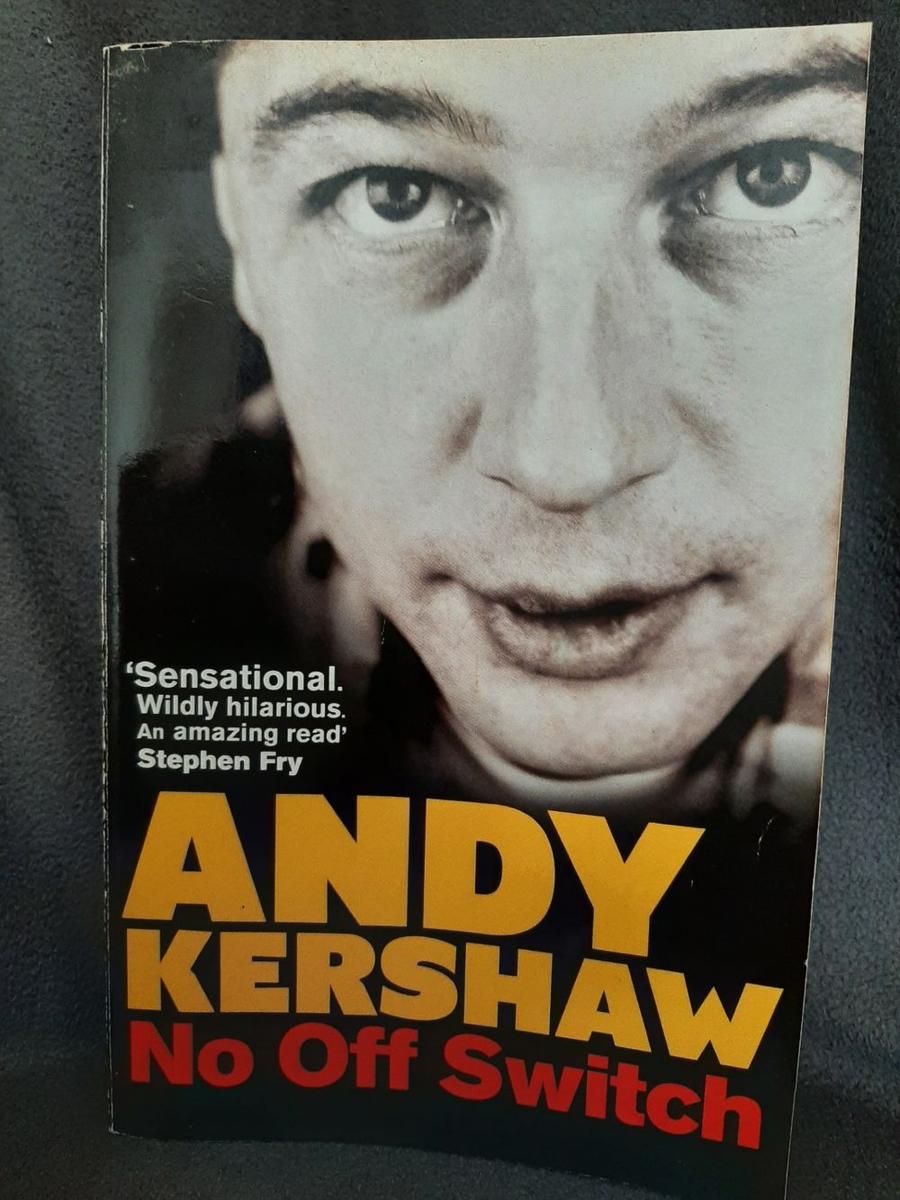
Kershaw was one of the BBC’s presenters for Live Aid, and that wasn’t his only experience of working in the live music scene. As a student at Leeds University, he rapidly gained the position of Ents Sec, putting on bands and running live shows. The Leeds Uni Stage Crew grew in reputation and became sought after to work at other events. Kershaw’s autobiography No Off Switch (2011) tells the story of how he and his team were recruited to work on The Rolling Stones 1982 gig at Roundhay Park. Kershaw was beset with unreasonable requests from a senior member of the Stones’ entourage which he was expected to fulfil at a moment’s notice. The perimeter fence had to painted green, but had to be redone several times because it was the wrong shade of green; a masseuse had to be found for Bill Wyman; a Japanese Water Garden (featuring a stream, a waterfall, a bridge, a pond and some koi carp) had to be sourced and installed in the Stones’ backstage area. The tables and chairs scattered throughout the garden were to have parasols with ‘Welcome, Rolling Stones’ on them written in Japanese script. Somehow, Kershaw and his team managed to fulfil all these requests, but he made one tiny alteration to the specifications. Having found a student at the University’s School of Oriental Studies with the necessary calligraphy skills, he instructed her to emblazon the umbrellas with the phrase (in Japanese, of course), ‘Fuck you, Rolling Stones.’ Somehow that episode, highlighting Kershaw’s resourcefulness, dedication to a task and his bloody-minded refusal to take the self-importance of the music industry seriously sums up the man. Farewell, Andy. You are sorely missed, but your footprint in my musical taste is huge.
There are no comments yet, be the first to comment...
Your comment will first need to be approved before it is visible.